Day 1: 6,000 feet to 10,000 feet
 |
| It begins. |
We woke up in Moshi at 6:30, had breakfast in the hotel, and then weighed our bags again. Somehow my duffel bag got heavier over night so I had to move stuff over to my daypack, making it uncomfortable and giving me something to whine about immediately. By 8:30 we were loaded up in a van with our guides and cook, driving to the Machame Gate of Kilimanjaro National Park, which sits at an elevation of 6,000 feet. We parked and our Tanzanian guides (Lyimo was our lead guide, and Dao was our assistant guide) started jumping through the necessary hoops to get our hiking permits. Two short hours later, we were off!
The refrain you’ll hear over and over if you hike Kilimanjaro is “pole pole” (pronounced “po-lay po-lay”). It means “slowly” in Swahili, and it’s essential when you reach the punishing altitudes of summit day. But in the earlier phases of hike, the pole-pole pace set by the guides seemed absurd; Andrew and I kept inadvertently walking too fast. Also part of the summit-day preparations was the schedule set by our guides: hike for an hour, rest for 15 minutes during which they make you eat a little and drink a lot. Again, these precautions are definitely not necessary during the early days, but they become essential on summit day and our guides were trying to establish good habits from the start.
The first day was a really great hike. We gained a ton of elevation and climbed through two climate zones. We started in a rainforest, tropical sort of environment, complete with monkeys running around the ample tree cover. Then we passed into a more arid environment with craggy rocks and crazy-looking plants. We only hiked 5 hours but I was exhausted by the time we got to camp at 10,000 feet.
Our porters had our tent set up and our duffel bags waiting for us. They took our water bottles to refill and, in the meantime, directed us to our dining tent, laid out with tea and popcorn. Andrew and I settled in for a nice little rehash of the day and were immediately joined by Dustin (who needs alone time?). Dinner was served at 6:30 by our waiter (who has a waiter on a mountain?!), Sumbi. Our cook, Mola, made vegetarian food for me at every meal, and Andrew and Dustin usually had a meat addition.
That first night Andrew and I were reading in our sleeping bags by 7:30, and falling asleep by 8:30. 10,000 feet can really take it out of you!
Day 2: 10,000 feet to 12,600 feet
We were back up at 6:30 the next morning and I immediately took Diamox, the altitude-sickness pill. I knew from the Inca Trail that I was *probably* susceptible to altitude sickness (I still claim I had food poisoning but deep down I know that wasn’t it), so I wasn’t going to mess around on Kilimanjaro. Today we were going to climb to 12,600 feet, which is almost as high as the tallest point on the Inca Trail, so I figured it was a good time to start Diamox.
Then we had breakfast in the dining tent (with Dustin) before packing our duffels and hitting the trail by 8:30.
It was a dusty forest hike with steep ascents that turned into more high plains and desert terrain. The steep ascents continued and we had great views of the Kili summit and Mount Meru off to the west. Before I knew it, we were arriving at camp and I was shocked at how short and easy the day was. The ascents were challenging, but I had braced for worse. And it was only 1:00!
 |
| Shira Camp, Night 2 |
Our tents were being set up and then we had our tea and popcorn again. Our porters also brought us a big bowl of hot water with a bar of soap, so Andrew and I took some basic tent baths.
Then we rested in our tent for a couple of hours, me complaining about
the amount of black snot I had (seriously, the dust on Kili is crazy) and my sore feet, Andrew suffering mild altitude sickness. Diamox was working great for me, but Andrew waited until that afternoon to take his and it hadn’t kicked in yet. It was affecting my ability to get a foot massage.
We
had dinner and an early night, but I woke up at 3:30 in the morning and
had to run out to the toilet tent to pee. It was definitely freezing.
My phone had lost almost 70% of its charge in a few hours because of the
cold so I shoved it in my shirt when I went back to bed to preserve the battery.
(Have I mentioned the toilet tent?! It was one of my favorite parts of the hike! It was just a little box on the ground with a toilet seat on top in a tall, skinny tent, but it was always clean. And since everyone else in our group canceled, the tent was only for me and Andrew!! Well, Dustin used it too. But I had anticipated the same nasty toilets I experienced on the Inca Trail, so the private tent was a massive upgrade.)
Day 3: 12,600 feet to 15,400 feet to 12,500 feet
We started with the same morning routine but it was definitely colder. We hiked uphill for about 4 hours, taking a 15-minute break every hour of hiking, as usual. It
was a difficult slog and my backpack was killing me (we had extra
layers because of the cold). At one point Dustin took a bunch of stuff
out my pack for me, which was a huge help.
 |
| Lyimo helping Andrew up the Lava Tower |
We got to the Lava Tower, which is not technically part of the hike (I think you’re supposed to sign extra forms saying the tour company isn’t liable if you die on the Tower), but Dustin was excited to be with such a small group and that Andrew and I were both in decent shape, so he suggested we
give it a shot. Aptly named, it’s a big tower of lava on the side of
the Machame Route. Most people take a lunch break at the base of the
tower and continue along the trail, but a few people decide to scale it for a little extra adrenaline. Andrew and I were going to be two of those people.
 |
| View from the Lava Tower |
I’m strictly a hiker, not a rock climber or boulderer, but the Lava Tower definitely required bouldering skills. Luckily, Dao was hanging out at the tower base with our bags, so we were unencumbered. Lyimo led the way and Dustin brought up the rear, and both guides earned their pay. At various points they each almost carried me and Andrew over crazy cliffs, boulders, and ledges. We made it to the top in about 20 minutes, basked in our pride for a few minutes, and then bouldered back down.
After a quick boxed lunch we were back on the trail, which I described in my journal as a “shit slog downhill.” It was not enjoyable. My knees were killing me and I was exhausted. But I couldn’t argue with the logic: you’re supposed to hike to a certain height each day and then hike back down to
a lower elevation to sleep. It helps people acclimate better and eases
symptoms of AMS. Regardless, I hate hiking downhill and was in a foul
mood. We had another early dinner at Barranco Camp and I was crawling into “bed” by 7:30.
Day 4: 12,500 feet to 14,000 feet to 13,000 feet
 |
| Barranco Wall bottleneck |
We got to sleep in an extra hour this morning because it was a short day that starts with a trail bottleneck, and our guides thought most groups would be gone if we started later. We left Barranco Camp by 9:30 and before long we were scaling the Barranco Wall, with porters scrambling past us carrying all our gear on their backs and heads. It was a lot up, down, up, and shitty down. I fell. Then there was some more steep uphill and before I knew it we were at camp. Days 4 and 5 were both short because we chose the 7-day route. The people who do the Machame Route in 6 days have to cram in our Day 4 and Day 5 hikes into Day 4. Suckers.
 |
| Typical trail lunch |
The altitude was starting to get to me, despite the Diamox. I felt nauseous, food seemed gross, and water made me want to vomit. But
I kept chugging the water and eating (I had to move to trail mix
instead of the hot lunch Malo made for us that day), and I upped my
Diamox dose that night before bed.
Day 5: 13,000 feet to 15,000 feet
Today was our “short” day but that’s open to interpretation. We were leaving Karanga Camp and heading to Barafu (High) Camp. It was only three hours that morning, but then we would start the summit at midnight the same day/night. But let’s not get ahead of ourselves.
My double dose of Diamox was working and I felt much better. It was still freezing at night but I was sleeping with my cell phone in my bra so I had enough battery for photos of the moon-like landscape we traversed that day. Again, it was short, but all uphill and difficult.
 |
| Moonscape |
We reached High Camp (which looks like a rock quarry) at noon, rested in the tent until lunch at 1:30, rested again, and packed for the summit (Dustin was
making us bring literally every layer we had because it was going to be
so cold. Makes sense, except my daypack was too heavy for this giant
baby.), and then ate dinner at 6. Dustin gave us the rundown of summit day again and kept our hopes up. After dinner, we “slept” until 11, when we had to get back up. Sumbi brought us some cookies, candy bars, and coffee in the dining tent. And then we had to put our layers on and get going.
Day 6: 15,000 feet to 19,300 to 15,000 to 10,000 feet
Our routine of hiking an hour and taking 15-minute breaks was all leading up to summit day. Also, just as Lyimo, Dao, and Dustin promised, our pole-pole pace felt too fast to sustain on summit day. It’s unbelievable how difficult it is do anything—walk,
breathe, carry a backpack—at 16,000 feet. In addition, every person who
was hiking the Machame Route with us was crammed into a small stretch
of trail at the same time. There was a crowded line of headlamps stretching all the way up the mountain. One of the groups kept singing like a bachelor party stumbling out of bar at 2:00 am. And to top it all off, I had gallons of
black snot dripping out of my nose constantly, but I had on thick
gloves and was holding hiking poles so I couldn’t do anything about it.
At Andrew’s suggestion, I started trying to shoot snot rockets, but I’d
never practiced before and I wasn’t very good.
At one point (I think it was only two hours in) Andrew asked Dustin to trade places. We had been in the following
order: Lyimo, me, Andrew, Dustin, Dao. But Andrew said I had started
dragging my right foot every time I took a step, and he was worried I
was going to careen of the mountain (I didn’t even know I was dragging my foot). Andrew was having a hard enough time getting himself up the mountain; he certainly wasn’t in a position to save me if I started stroking out. Besides, we were paying Dustin; he might as well be the middle piece of bread in our guide sandwich and catch me if I fell.
Another of my highlights came when I really needed one of those 15-minute breaks but knew we weren’t
close. I asked Dustin how long we had been hiking since our last break
and he said it had only been 30 minutes. He asked if I could make it
another 15 minutes before our next break and I dispiritedly said okay. The next few minutes felt like hours. Lyimo navigated us off the trail so we could pass a giant group and I began to feel claustrophobic. The bachelor party started “Oy!, Oy!, Oy!ing” again and I had a mini-panic attack. It felt like this was going to be my life, forever, from here on out. I was never going to get off the trail, it was always going to be dark and cold and crowded with Australians yelling in the background and I couldn’t handle it anymore. I started crying and sat down on the nearest rock. Fuck it, it was break time.
Dustin’s number-one rule for our summit-day breaks was to immediately put on our parkas as soon as we stopped walking to preserve body heat. It was freezing and moving was the only thing keeping us warm. But I was wearing so many top layers already (2 long-underwear shirts, 2 fleece jackets, and a rain jacket) that I couldn't move my shoulders enough to put on the parka. Dustin had to help me; that, combined with the snot all over my face and my spontaneous crying, made me feel like a toddler..
Before I was ready, Dustin made us get going again. We packed up our food and water, shoved our parkas in our packs, and hit the trail. But not before Lyimo insisted on taking my backpack for me, even though he was carrying one of his own. I think the guides consider crying to be a red flag.
 |
| Summit Day |
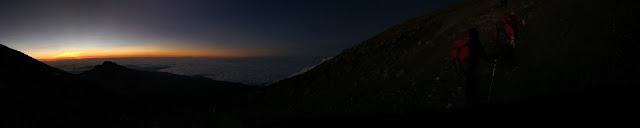
The early morning hours slowly dragged out in the same manner, but I managed not to break down again. We kept plodding and breaking and drinking water and apparently I kept dragging my right foot. The sun finally started peaking over the horizon (it boosted my mood significantly) and by the time we made it to Stella Point, it was fully out. Stella Point is right on the rim of the Kili volcano, and is only 500 feet from Uhuru Peak, but it takes almost an hour to walk those 500 feet along the rim to reach the highest point of Kilimanjaro.
 |
| I'm barely moving. |
Along
the way, we passed a glacier and saw down into the crater. It was
stunning but I was also barely able to move one foot in front of the
other. I was exhausted and shuffling along miserably. We saw some people walking down the other way, clearly elated at having summited the mountain. I hated them. More comforting to me were the people having breakdowns on the side of trail and the ones being dragged up the trail by their guides.
Then finally, amazingly, at 7:20 in the morning, we got to Uhuru Peak! There were people up there taking photos by the sign, and their guides were hanging out chatting with each other. I felt overwhelmed and not particularly happy (or sad for that matter, I had no idea how I was feeling), but I started crying again. I didn’t know why and Dao was confused too. He came over with a big smile and said, “You made it! You don’t have to cry anymore!” I nodded and if I could have talked I would have told him I didn’t even know why I was crying, but I also couldn’t stop.
We stood in line to take our picture in front of the sign, me wiping my eyes and trying unsuccessfully to get it together, leaning on Andrew. He kept turning around to check on me, clearly as confused by my behavior as I was. Finally the group in front of us moved out of the way and we stumbled up to the sign. Andrew and I got a couple pictures of just the two of us and then Dustin and Dao joined us (Lyimo was waiting at Stella Point with my backpack).
 |
| Can you see the tears? |
After the photo op, I sat on a rock and ate my celebratory Snickers bar, and then we had to head back down. Uhuru Peak is so high that you’re not allowed to hang out up there for long. Heading down to Stella Point was amazing.
I felt completely refreshed, and my body wasn’t struggling with each
step anymore. I was one of those annoying, cheerful people heading back
down and trying to encourage those struggling to make it up. I had been that person just 20 minutes ago, but now it was a whole new world. I could breathe better, I could actually look around at my surroundings as we walked, and I felt happy.
The stretch of
trail from Stella Point back to Barafu Camp was the best downhill I can
remember ever doing, but also a little scary. Most of it was loose
scree, so rather than actually walking down, we half-skied, half-ran, with a few butt-scoots thrown in for good measure. The few treacherous, rocky downhill parts were easy for me, too, because Dao had realized how much I suck going down and decided to hold my hand,
literally, whenever we got to a hard part. It was about three hours to
Barafu where we had lunch and packed up, and then we had to keep going
down. The camp is too small for anyone to stay the night twice; people who were about to summit needed our spot.
The rest of the day was more what I expect from descents: pain, misery, broken-knee sensations, and a very slow pace. We made it Mweka camp by 4:30 and I immediately crashed in the tent. I slept through tea and popcorn, dragged myself out for dinner at 6:30 but, with no appetite, I excused myself and went right back to sleep. Andrew and Dustin had a nice, quiet dinner together.
Day 7: 10,000 feet to 6,000 feet
 |
| All done! |
We
were up at 5:45 the next morning (I think it was so early because Lyimo
and Dao understood my pace was going to take longer than they were used
to)
to eat our last camp breakfast, pack up, and hit the trail by 7. It was
another punishing day for me, 4.5 hours of straight descent, but we
finally got to Mweka Gate at the exit of the park, passing more monkeys along the way.
I decided they’re the Wal-Mart greeters of the Kilimanjaro National
Park: they welcomed us on Day 1 and they said farewell on Day 7.
Andrew and I took a happy photo at the park exit (the relief and joy on my face is genuine)
and said goodbye to the mountain that had been our home for a week. It
was an exhausting experience, definitely harder than I expected, but
hugely satisfying to accomplish. Would I do it again? Nope, one time is plenty for me. But I am glad I did it once!


